


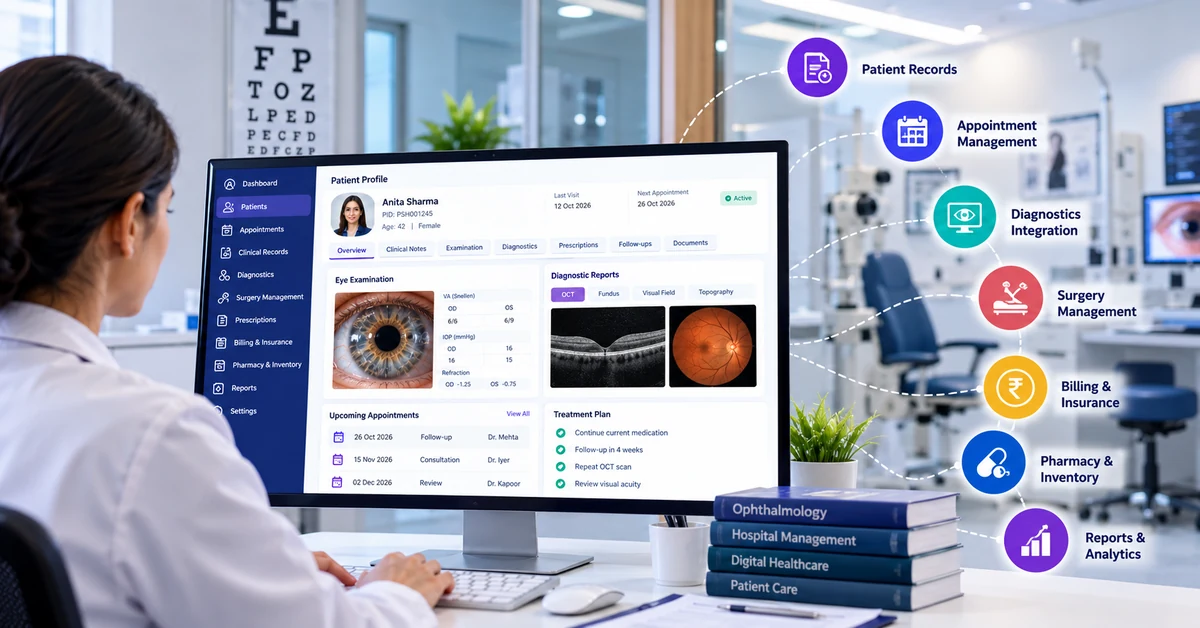
Managing a modern eye hospital involves much more than maintaining patient records. From appointments and diagnostics to surgeries, billing, pharmacy, insurance, and follow-up care, multiple departments need to work together efficiently. This is where the best Eye hospital software can make a significant difference.
A well-designed digital solution can connect clinical and administrative workflows, reduce manual work, improve access to patient information, and help healthcare teams deliver a more organized patient experience.
But with many healthcare software options available, how do you choose the right one for an eye hospital? The answer depends on whether the software can support both general hospital operations and the specialized requirements of ophthalmology.
What Is Eye Hospital Software?
Eye hospital software is a digital healthcare management solution designed to help ophthalmology clinics and hospitals manage their clinical, administrative, and operational activities from a centralized platform.
Unlike basic hospital management systems, ophthalmology-focused software can support workflows related to eye examinations, diagnostic reports, surgeries, prescriptions, follow-ups, and other eye-care requirements.
The right platform should make information easier to access while helping doctors, nurses, administrators, and other staff work from connected and accurate data.
Why Is Choosing the Right Eye Hospital Software Important?
Eye hospitals handle a large volume of patient and diagnostic information every day. Managing this information through paper files, spreadsheets, or disconnected systems can create delays and increase the possibility of errors.
The right software can help hospitals:
- Maintain centralized digital patient records
- Streamline appointment scheduling
- Organize diagnostic information
- Manage surgical workflows
- Simplify billing and insurance processes
- Improve patient follow-ups
- Track hospital performance through analytics
- Provide controlled access to healthcare information
For growing hospitals, scalability is equally important. A solution should be capable of supporting increasing patients, doctors, departments, and locations without creating unnecessary operational complexity.
Key Features to Look for in the Best Eye Hospital Software
1. Comprehensive Electronic Medical Records
A strong EMR system should allow healthcare professionals to access relevant patient information from a centralized location.
For ophthalmology, records may include medical history, examination findings, prescriptions, diagnostic reports, treatment plans, and follow-up information.
This reduces dependence on physical files and allows authorized healthcare professionals to retrieve information when needed.
2. Ophthalmology-Specific Clinical Workflows
Generic healthcare software may not always address the specific requirements of eye hospitals.
Look for software that can support ophthalmology workflows such as visual acuity records, eye examination documentation, diagnostic information, treatment planning, and procedure-related records.
Specialized workflows can help doctors spend less time navigating the system and more time focusing on patients.
3. Appointment and Queue Management
Efficient appointment management is essential for busy eye hospitals.
The software should make it easy to schedule appointments, manage doctor availability, track patient queues, and coordinate follow-up visits.
A centralized appointment system can also help reduce scheduling conflicts and improve the overall patient journey.
4. Diagnostic Integration
Modern eye hospitals use several diagnostic technologies and imaging systems. Managing these reports separately can make it difficult to access a complete view of a patient’s condition.
The best Eye hospital software should support integration with relevant diagnostic workflows wherever possible, allowing healthcare teams to access important reports and clinical information alongside patient records.
5. Surgery and Procedure Management
Eye hospitals often manage procedures such as cataract surgeries and other ophthalmic interventions.
A suitable platform should help organize pre-operative assessments, procedure-related information, scheduling, documentation, and post-operative follow-ups.
This creates better coordination between clinical teams and administrative staff.
6. Billing and Insurance Management
Financial management is another important component of hospital operations.
Eye hospital software should support billing, invoices, payments, insurance-related processes, and financial reporting. Connecting billing with patient and treatment information can reduce repetitive data entry and improve administrative efficiency.
7. Pharmacy and Inventory Management
Hospitals may need to manage medicines, consumables, surgical materials, and other inventory.
Integrated inventory management can help teams monitor stock levels, usage, purchases, and availability. This becomes especially useful for hospitals handling high patient volumes.
8. Patient Communication and Follow-Up
Patient engagement does not end after a consultation.
Digital software can support appointment reminders, follow-up scheduling, notifications, and communication workflows. Better follow-up management can help hospitals maintain continuity of care and provide patients with a more organized experience.
9. Analytics and Reporting
Healthcare administrators need visibility into hospital performance.
Modern software should provide useful reports and dashboards covering areas such as patient volumes, appointments, revenue, procedures, doctor performance, and operational trends.
Analytics can help management identify bottlenecks and make more informed decisions.
10. Cloud Access and Data Security
Cloud-based healthcare platforms can provide authorized users with access to relevant information from different locations and devices.
However, accessibility must be balanced with security. Look for features such as role-based access, authentication, secure data handling, audit controls, and appropriate privacy measures.
Generic Hospital Software vs. Ophthalmology-Focused Software
Not every hospital management platform is designed for eye care.
A generic solution may cover basic functions such as registration, billing, appointments, and patient records. An ophthalmology-focused platform can go further by supporting eye-care-specific clinical workflows and diagnostic information.
| Feature | Generic Hospital Software | Ophthalmology-Focused Software |
| Patient records | ✓ | ✓ |
| Appointment management | ✓ | ✓ |
| Billing | ✓ | ✓ |
| Eye examination workflows | Limited | ✓ |
| Ophthalmology diagnostics | Limited | ✓ |
| Eye surgery workflows | Limited | ✓ |
| Ophthalmology-specific records | Limited | ✓ |
| Eye-care reporting | Limited | ✓ |
For an eye hospital, choosing a platform that understands ophthalmology workflows can make implementation and everyday use more effective.
How to Choose the Right Eye Hospital Software
Before making a decision, hospitals should evaluate the software based on their current and future requirements.
Consider the following:
Understand your workflows: Identify how registration, consultation, diagnostics, surgery, billing, pharmacy, and follow-ups currently work.
Evaluate usability: A complicated interface can reduce adoption among doctors and staff.
Check integration capabilities: Make sure the platform can connect with relevant diagnostic and operational systems where required.
Review security: Patient information requires appropriate access controls and security measures.
Consider scalability: Choose software that can grow with your hospital.
Assess support and training: Implementation support, onboarding, training, and ongoing assistance can significantly affect long-term success.
How Purple Sky Health Supports Modern Eye Care
Purple Sky Health provides a cloud-based digital healthcare platform designed to help healthcare providers manage clinical and administrative workflows through a connected digital environment.
The platform supports areas such as patient records, appointments, billing, insurance, analytics, and other healthcare operations. For organizations looking to improve digital coordination, an integrated healthcare platform can provide a more connected approach to managing day-to-day activities.
The Future of Digital Eye Hospital Management
Technology is expected to play an increasingly important role in eye-care delivery and hospital operations. Artificial intelligence, connected diagnostic systems, cloud platforms, analytics, and automated workflows can create new opportunities for improving efficiency.
However, technology should support healthcare professionals rather than add unnecessary complexity. The most effective solutions will combine usability, specialized clinical workflows, secure data management, interoperability, and actionable insights.
Conclusion
Choosing the best Eye hospital software is not simply about selecting a system with the largest number of features. Hospitals should look for a solution that fits their clinical workflows, supports ophthalmology-specific requirements, connects departments, protects patient information, and can scale as the organization grows.
From electronic medical records and diagnostics to surgery management, billing, analytics, and patient follow-ups, the right software can help create a more efficient and connected eye-care environment.
FAQs
1. What is the best Eye hospital software?
The best solution depends on the hospital’s requirements, but it should ideally support EMR, ophthalmology workflows, diagnostics, appointments, surgery, billing, analytics, security, and scalability.
2. What features should eye hospital software have?
Important features include digital patient records, appointment management, diagnostic integration, ophthalmology workflows, surgery management, billing, inventory, analytics, patient communication, and secure cloud access.
3. Can eye hospital software manage diagnostic information?
Yes. Ophthalmology-focused platforms can help organize diagnostic information and, depending on the system, integrate with relevant diagnostic technologies.
4. Is cloud-based software suitable for eye hospitals?
Cloud-based software can provide authorized access to healthcare information across locations while supporting centralized management and scalability. Security controls should always be evaluated before implementation.
5. How can eye hospital software improve efficiency?
It can reduce manual processes, centralize patient information, streamline appointments and billing, improve departmental coordination, and provide analytics for better operational decision-making.