


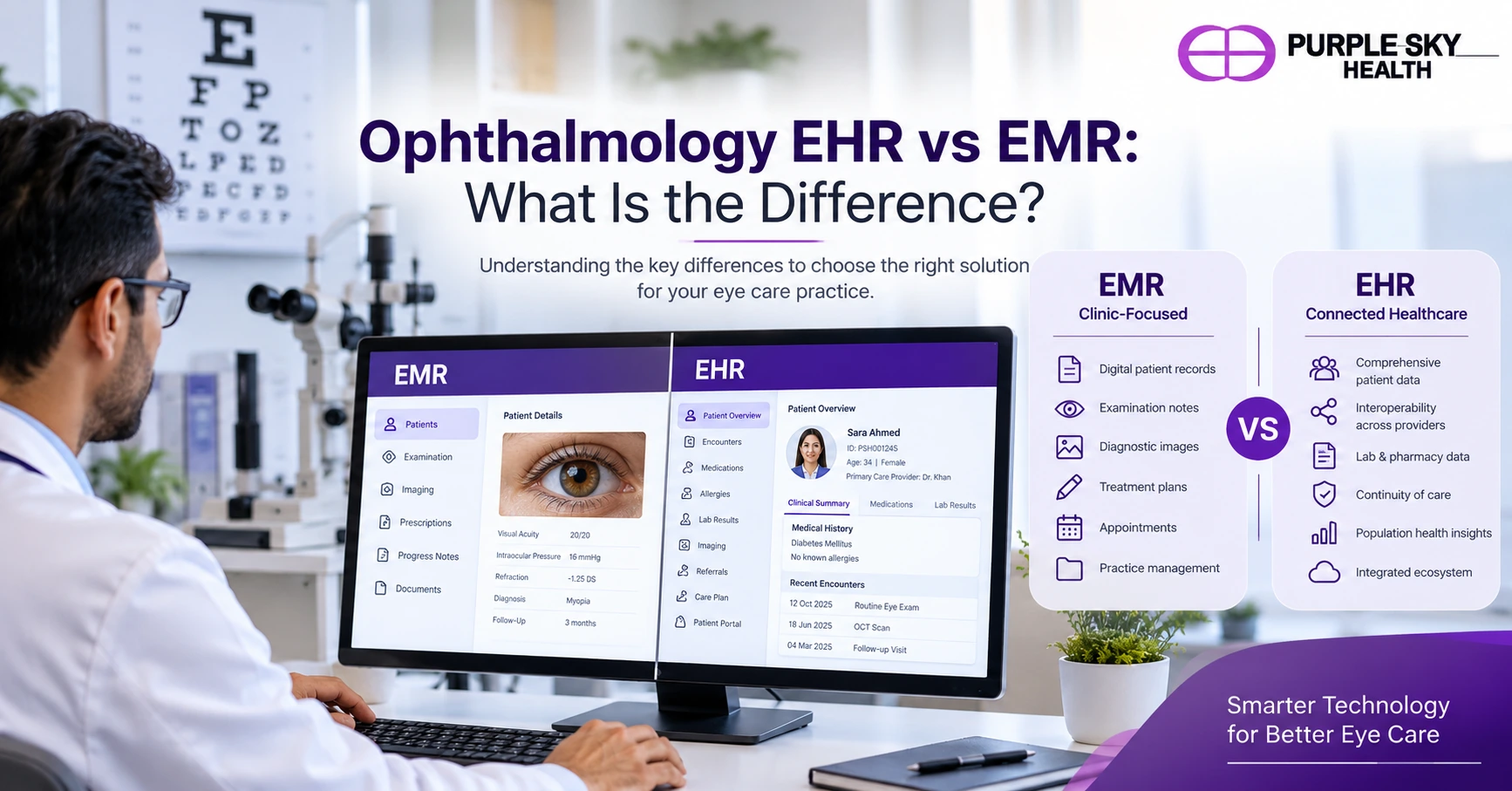
Digital healthcare has changed the way medical practices store, access, and manage patient information. For eye clinics and hospitals, moving from paper-based records to digital systems can make it easier to organize clinical information, manage appointments, document examinations, and coordinate patient care.
Two terms commonly used in healthcare technology are EMR (Electronic Medical Record) and EHR (Electronic Health Record). Although they are sometimes used interchangeably, there are important differences between the two.
Understanding these differences can help ophthalmologists, clinic owners, and hospital administrators choose a digital solution that matches their operational and clinical requirements.
What Is an EMR?
An Electronic Medical Record (EMR) is a digital version of a patient’s medical record maintained within a particular healthcare practice or organization.
Instead of storing information in physical files, an EMR allows healthcare professionals to digitally document and access information such as:
- Patient demographics
- Medical history
- Clinical notes
- Diagnosis information
- Examination findings
- Prescriptions
- Treatment records
- Follow-up details
- Billing information, depending on the system
For an ophthalmology practice, an EMR can be particularly useful for maintaining organized records related to eye examinations, visual acuity, clinical observations, treatment plans, and follow-up visits.
What Is an EHR?
An Electronic Health Record (EHR) is designed with a broader perspective. In addition to maintaining a patient’s medical information, an EHR can support the sharing and exchange of health information across different healthcare providers or settings when appropriate systems and interoperability standards are available.
For example, a patient’s information may need to be accessed by different departments, specialists, laboratories, hospitals, or other authorized healthcare professionals involved in their care.
An EHR therefore focuses not only on maintaining a digital record but also on supporting continuity and coordination of care.
Ophthalmology EHR vs EMR: What Is the Difference?
The primary difference lies in the scope of information management and information exchange.
| Feature | EMR | EHR |
| Digital patient records | Yes | Yes |
| Clinical documentation | Yes | Yes |
| Patient history | Yes | Yes |
| Practice-level management | Strong | Strong |
| Information exchange | Usually more limited | Designed for broader interoperability |
| Cross-provider information | May be limited | Better suited to coordinated care |
| Long-term health record | Practice-focused | Broader patient health record |
An EMR is often focused on the patient’s record within a particular practice, while an EHR is designed to support a more comprehensive health record that can potentially follow the patient across different points of care.
Why Does This Difference Matter in Ophthalmology?
Ophthalmology involves detailed clinical information that may need to be monitored over multiple visits. Patients may also move between optometrists, ophthalmologists, diagnostic centers, hospitals, and other specialists.
A digital system can help clinicians maintain a structured history of the patient’s eye health. Depending on the platform, this can include examination findings, prescriptions, diagnostic reports, procedure information, and follow-up notes.
For larger practices and healthcare networks, the ability to connect information across different departments or locations can become particularly important.
Key Features of Ophthalmology EMR Software
An ophthalmology-focused EMR may include features designed around the workflow of an eye clinic.
Patient Registration and Profiles
Digital registration allows staff to maintain patient demographic information and access previous records without searching through physical files.
Clinical Documentation
Doctors can record examination findings, diagnoses, treatment plans, prescriptions, and follow-up instructions electronically.
Appointment Management
Digital appointment scheduling can help clinics organize consultations, follow-ups, and other patient visits.
Diagnostic Information
Depending on the software, diagnostic reports and information from ophthalmic equipment may be incorporated into the patient’s digital record.
Billing and Payments
Some healthcare platforms connect clinical workflows with billing, helping practices manage financial information alongside patient records.
Reporting and Analytics
Practice-level reports can provide insights into patient volumes, appointments, revenue, and other operational metrics.
Key Features of an Ophthalmology EHR
An EHR can provide many of the same core capabilities as an EMR while placing greater emphasis on broader health information management and interoperability.
Depending on the platform, an ophthalmology EHR may support:
- Comprehensive patient health records
- Clinical documentation
- Diagnostic information
- Medication and prescription records
- Referrals
- Laboratory information
- Billing and insurance workflows
- Data exchange
- Analytics
- Multi-location access
The exact capabilities vary between healthcare software providers, so clinics should evaluate the features rather than relying solely on whether a product is labelled “EMR” or “EHR.”
EMR or EHR: Which Is Better for an Eye Clinic?
There is no universal answer. The right option depends on the size and requirements of the organization.
A small ophthalmology clinic that primarily needs digital patient records, appointment management, clinical documentation, and billing may find an EMR-style system sufficient.
A larger hospital, multi-specialty facility, or healthcare network may benefit from broader EHR capabilities, particularly when information needs to move between different departments or healthcare providers.
The most important consideration is whether the software supports the clinic’s actual workflow.
Cloud-Based Ophthalmology Software
Cloud-based healthcare platforms have become increasingly useful for organizations that need secure access to information across different locations.
Instead of relying entirely on software installed on a single computer, cloud-based systems can allow authorized users to access information through connected devices, depending on the platform’s architecture and security controls.
For multi-location ophthalmology groups, this can make centralized management and access more convenient.
However, healthcare organizations should carefully evaluate data security, access controls, backups, compliance requirements, and vendor support before selecting a cloud-based system.
How Purple Sky Health Supports Digital Healthcare Operations
Purple Sky Health is a digital healthcare technology platform designed to bring multiple healthcare workflows together within a cloud-based environment.
Its platform supports healthcare professionals across clinics, hospitals, laboratories, and pharmacies, helping them manage areas such as patient records, appointments, billing, insurance, and analytics.
With a presence spanning regions including the Middle East, Africa, and Asia, Purple Sky Health focuses on using connected technology and data-driven capabilities to make healthcare operations more organized and efficient.
For healthcare providers considering a transition from traditional record keeping to a more comprehensive digital environment, platforms such as Purple Sky Health can offer an integrated approach rather than treating patient records, administration, billing, and analytics as completely separate processes.
Benefits of Moving From Paper Records to Digital Systems
Whether a healthcare organization chooses an EMR or EHR, digitalization can offer several practical benefits.
Faster Access to Information
Authorized staff can retrieve patient information without searching through physical files.
Better Organization
Digital records can make it easier to organize patient histories, appointments, prescriptions, and clinical documentation.
Reduced Administrative Work
Automated workflows can reduce repetitive paperwork and allow staff to spend more time on patient-facing activities.
Easier Data Analysis
Digital information can be used to generate reports and operational insights that may be difficult to obtain from paper records.
Improved Continuity of Care
When information is appropriately available to authorized healthcare professionals, digital records can support better coordination between different stages of care.
What Should You Consider When Choosing Ophthalmology Software?
Before selecting an EMR or EHR system, ophthalmology practices should consider:
- Ophthalmology-specific workflows – Does the system support the clinical processes used by eye-care professionals?
- Ease of use – Can doctors and staff learn and use the platform efficiently?
- Patient record management – Can it maintain comprehensive and organized records?
- Diagnostic integration – Can relevant diagnostic information be incorporated into the patient’s record?
- Billing and insurance – Does the system support the financial workflows required by the practice?
- Security – What safeguards are available to protect patient information?
- Scalability – Can the system support the organization as it grows?
- Cloud access – Is secure access available across locations where required?
- Reporting and analytics – Can administrators obtain useful operational insights?
- Technical support – Is reliable assistance available when issues arise?
Final Thoughts
The difference between an EMR and an EHR primarily comes down to their scope. An EMR generally focuses on maintaining a patient’s digital medical record within a particular practice, while an EHR is designed to support a broader health record and coordination of information across healthcare settings.
For ophthalmology practices, the terminology matters less than the actual functionality of the software. A suitable platform should support clinical documentation, patient management, diagnostic information, appointments, billing, security, and other workflows relevant to the organization.
As healthcare continues to become more digital, solutions such as Purple Sky Health demonstrate how multiple clinical and administrative functions can be brought together through connected technology. Choosing the right system can help ophthalmology practices build a more organized, scalable, and digitally enabled healthcare environment.
Frequently Asked Questions
An EMR is generally focused on a patient’s digital medical record within a specific healthcare practice, while an EHR has a broader focus and is designed to support health information exchange and continuity of care across healthcare settings.
Not necessarily. The better option depends on the organization’s needs. A small eye clinic may need primarily practice-focused record management, while a hospital or multi-location network may benefit from broader EHR capabilities.
Useful features can include patient registration, clinical documentation, appointment management, prescriptions, diagnostic information, billing, reporting, and secure patient record management.
Some platforms can integrate or incorporate information from diagnostic systems and ophthalmic devices. The exact integration capabilities depend on the software and supported equipment.
It can be useful because authorized users may be able to access centralized information across locations. However, healthcare organizations should assess security, access controls, compliance, connectivity, and vendor support before implementation.
Yes. An EMR can digitally maintain patient information such as medical history, clinical notes, examination findings, prescriptions, diagnoses, and follow-up records, depending on the platform.
Purple Sky Health is a cloud-based digital healthcare platform that brings together functions such as patient records, appointments, billing, insurance, and analytics for healthcare organizations including clinics, hospitals, laboratories, and pharmacies.
Digital software can help organize patient information, streamline administrative workflows, improve access to records, support reporting, and reduce dependence on paper-based processes.