


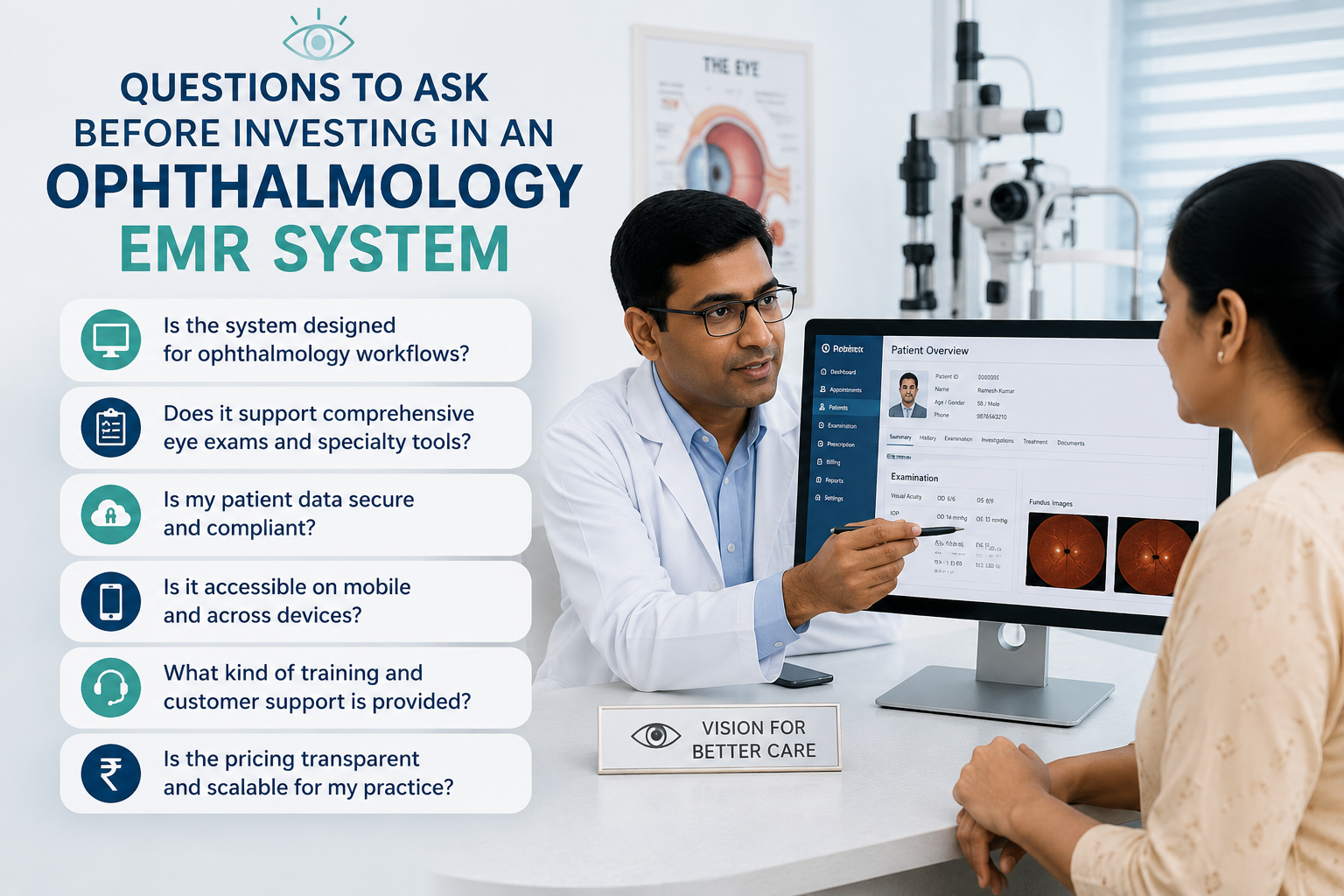
The healthcare industry is rapidly embracing digital transformation, and ophthalmology practices are no exception. From managing patient records and appointments to handling diagnostics, surgeries, billing, and inventory, modern eye hospitals require technology that supports both clinical and operational excellence.
However, choosing the right Ophthalmology EMR (Electronic Medical Record) system is a critical decision. The software you invest in today will influence your workflow efficiency, patient experience, data management, and long-term growth for years to come.
Before selecting an Ophthalmology EMR system, it is important to ask the right questions to ensure that the solution truly meets the unique requirements of your eye care practice.
Is the EMR Designed Specifically for Ophthalmology?
One of the first questions every eye hospital or clinic should ask is whether the software has been built specifically for ophthalmology. Generic healthcare software often lacks specialized workflows required for eye care practices.
Ophthalmologists need features such as visual acuity recording, refraction management, diagnostic image integration, surgical documentation, treatment tracking, and long-term patient history management. A dedicated ophthalmology-focused EMR can help streamline these processes while reducing administrative burden and improving clinical efficiency.
Can the System Manage Both Clinical and Administrative Workflows?
Many healthcare organizations make the mistake of investing in software that focuses only on patient records while ignoring operational requirements.
An effective Ophthalmology EMR should support appointment scheduling, billing, insurance management, inventory tracking, reporting, and patient communication alongside clinical documentation. A unified platform eliminates the need for multiple disconnected systems and improves coordination across departments.
The more integrated the solution, the easier it becomes to manage daily operations efficiently.
How Secure Is Patient Data?
Patient information is one of the most sensitive assets within any healthcare organization. Data breaches, unauthorized access, and poor security practices can result in serious legal and reputational consequences.
Before investing in an EMR system, ask about data encryption, access controls, audit trails, backup mechanisms, and compliance with healthcare data protection standards. The right software should provide strong security while ensuring that authorized healthcare professionals can access information when needed.
A secure system helps build patient trust and supports long-term operational reliability.
Does the Software Support IOL Management?
For eye hospitals, Intraocular Lens (IOL) management is a critical operational requirement. Different surgeries require different lens models, and hospitals often maintain extensive inventories supplied by multiple vendors.
Without proper tracking, hospitals may experience inventory discrepancies, unbilled lens usage, and revenue leakage. A modern Ophthalmology EMR should include a dedicated IOL Management Library that tracks lens inventory, batch numbers, manufacturers, stock levels, and patient allocation.
This capability helps ensure accurate billing, better inventory visibility, and complete traceability for every implanted lens.
Can It Handle Optical Inventory Management?
Many eye hospitals and vision centers operate optical stores that sell frames, lenses, and accessories. Managing these products manually can lead to stock mismatches, billing errors, and lost revenue.
When evaluating an EMR system, ask whether it supports barcode-enabled inventory management. Barcode tracking allows hospitals to monitor product movement, automate stock updates, and improve billing accuracy.
Integrated optical inventory management helps maintain better control over inventory while reducing administrative workload.
How Well Does the Billing System Work?
Billing is one of the most important functions of any healthcare facility. Even small billing errors can result in claim rejections, delayed payments, patient disputes, and revenue loss.
An effective Ophthalmology EMR should automate billing workflows, integrate with patient records, support insurance processing, and reduce manual data entry. Automated billing helps ensure that every consultation, diagnostic test, surgery, lens, and optical product is correctly reflected in invoices.
Accurate billing contributes directly to healthier revenue cycle management.
Is the System Scalable for Future Growth?
Many eye clinics begin as single-location practices but expand over time. Investing in software that cannot grow with your organization may lead to costly migrations in the future.
Ask whether the system can support multiple branches, increasing patient volumes, additional users, and expanded services. A scalable platform allows healthcare providers to continue using the same software as their practice evolves.
Long-term scalability is often one of the most important factors when selecting healthcare technology.
Does the Vendor Provide Ongoing Support?
Even the best software requires training, implementation assistance, and ongoing technical support. Healthcare organizations should evaluate the vendor’s ability to provide timely help whenever issues arise.
Reliable support ensures that users can resolve technical challenges quickly and continue operating without unnecessary disruptions. Training programs, onboarding assistance, and responsive customer service can significantly improve software adoption and long-term success.
Can the System Provide Meaningful Analytics?
Healthcare providers generate large amounts of operational and clinical data every day. Without proper analytics tools, much of this information remains underutilized.
A modern Ophthalmology EMR should provide real-time dashboards, financial reporting, patient trends, inventory insights, and operational performance metrics. These analytics help hospital administrators make informed decisions and identify opportunities for improvement.
Data-driven decision-making is becoming increasingly important in modern healthcare management.
How Purple Sky Health Supports Digital Eye Care
Healthcare organizations today require technology that goes beyond basic record keeping. Purple Sky Health delivers a cloud-based healthcare platform designed to simplify clinical, administrative, and operational workflows across healthcare organizations.
Trusted by thousands of healthcare professionals across multiple regions, the platform supports everything from patient management and appointments to billing, insurance processing, analytics, and operational reporting. By combining intelligent technology with healthcare-focused innovation, Purple Sky Health helps providers improve efficiency while maintaining high standards of patient care.
Why WebNetram Is Built for Modern Ophthalmology Practices
Developed by Purple Sky Health, WebNetram is a specialized Ophthalmology EMR and Eye Hospital Management Software designed specifically for eye care providers.
WebNetram goes beyond traditional EMR functionality by combining patient records, appointment management, billing, diagnostics, IOL Management Library, barcode-enabled optical inventory management, insurance processing, and operational reporting within a single platform.
Its ophthalmology-focused design helps clinics, vision centers, and eye hospitals improve workflow efficiency, reduce billing errors, strengthen inventory control, and maintain better visibility across clinical and administrative operations.
By addressing the unique requirements of eye care providers, WebNetram helps organizations build a stronger foundation for long-term growth and operational excellence.
Conclusion
Investing in an Ophthalmology EMR system is one of the most important technology decisions an eye hospital or clinic can make. The right platform should not only support patient records but also streamline billing, inventory management, operational workflows, and long-term growth.
By asking the right questions before making a decision, healthcare providers can select a solution that aligns with their clinical and business objectives. Platforms such as WebNetram, developed by Purple Sky Health, demonstrate how specialized ophthalmology software can help eye care organizations improve efficiency, strengthen operational control, and deliver a better experience for both patients and healthcare professionals.