


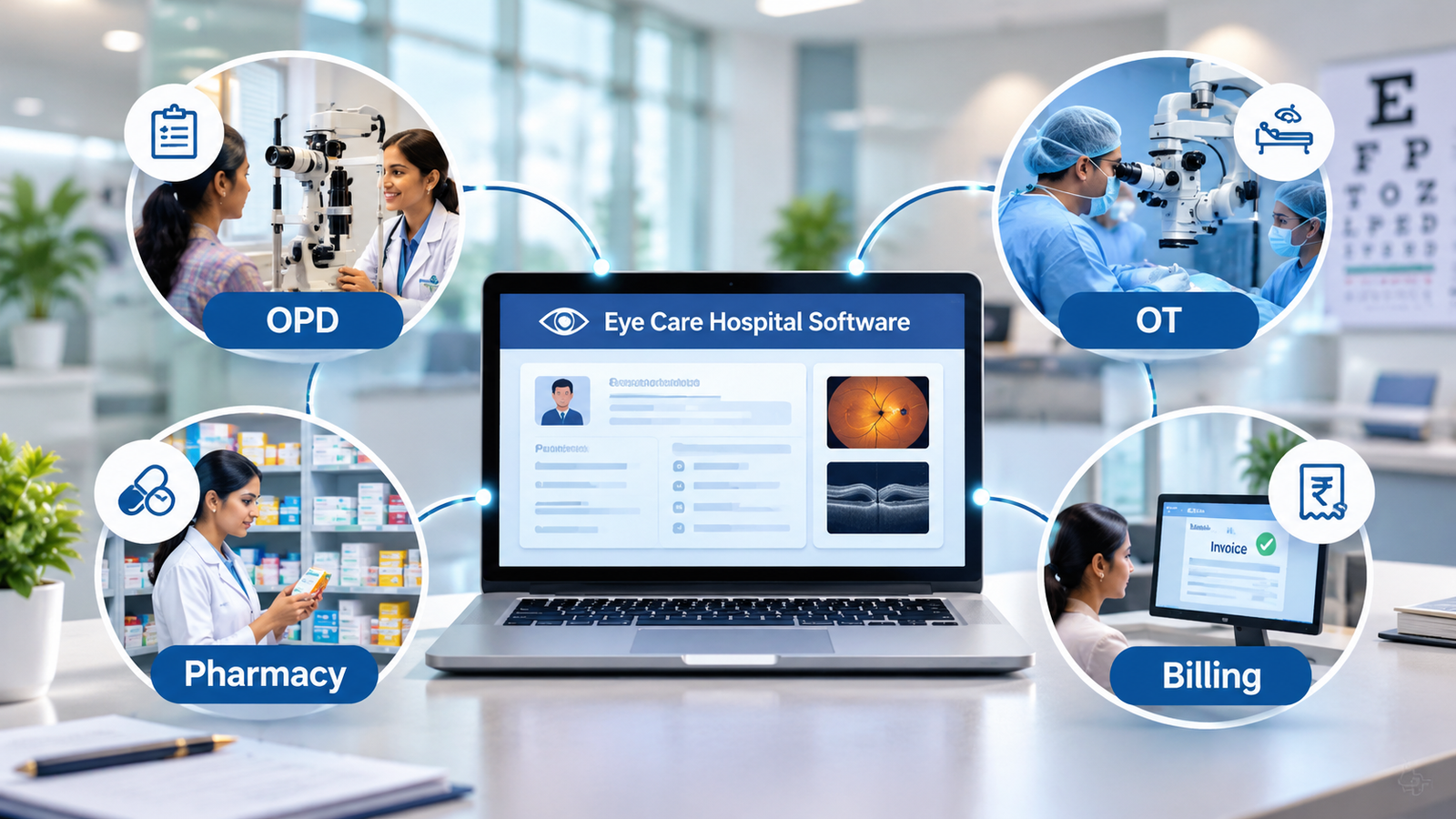
Modern eye hospitals handle multiple clinical and administrative activities every day. From patient registration and eye examinations to surgical procedures, medicine dispensing and billing, every department plays an important role in delivering quality eye care.
However, managing these activities through separate systems can create communication gaps, repeated data entry and delays in daily operations. Doctors may need to access patient information from different records, OT staff may depend on manually shared surgery details, and billing teams may have to collect information from multiple departments.
This is where Eye Care Hospital Software becomes important. An integrated digital platform helps connect different hospital departments, organize patient information and coordinate routine workflows through a centralized system.
An ophthalmology-focused EMR solution takes this further by supporting the specific clinical and administrative requirements of eye hospitals.
What Is Integrated Eye Care Hospital Software?
Eye Care Hospital Software is a digital management system designed to help eye clinics and hospitals manage their daily operations. It can bring different activities, such as patient registration, OPD consultations, clinical documentation, surgery management, pharmacy operations and billing, into a connected environment.
Unlike basic hospital management systems, an ophthalmology-focused platform is designed around eye care workflows. It can support ophthalmologists in maintaining clinical records, managing diagnostic information and coordinating treatment-related activities.
An integrated system helps departments work with relevant patient information instead of maintaining completely separate records.
1. Connecting OPD Management with Patient Records
The Outpatient Department (OPD) is generally the first stage of a patient’s journey in an eye hospital. It handles patient registration, appointments, consultations and initial clinical assessments.
When OPD operations are managed digitally, hospital staff can organize patient information and make relevant records accessible to authorized healthcare professionals.
An Ophthalmology Software EMR Solution can support OPD activities through:
- Digital patient registration and record management.
- Appointment scheduling and consultation workflows.
- Electronic clinical documentation.
- Recording diagnoses and treatment recommendations.
- Maintaining patient examination history.
For example, when a patient visits an eye hospital for a cataract consultation, the ophthalmologist can document the examination findings and recommended treatment. This information can support further diagnostic evaluation and surgery planning.
2. Connecting OPD with Operation Theatre Management
The Operation Theatre (OT) department handles important activities related to surgical procedures. In an eye hospital, these may include cataract surgery, glaucoma procedures and other ophthalmic operations.
Managing surgery-related information separately from OPD records can increase administrative work and create communication challenges.
Integrated Eye Care Hospital Software helps coordinate consultation details with surgery-related workflows.
Important areas include:
- Surgery scheduling and planning.
- Access to relevant patient information.
- Pre-operative documentation.
- OT coordination and procedure records.
- Management of surgery-related information.
For cataract procedures, hospitals also need to maintain accurate intraocular lens (IOL) information. An ophthalmology EMR system with IOL management capabilities can help organize lens details and associate relevant information with patient records.
This connection helps clinical and administrative teams work with more organized information during the surgical process.
3. Connecting Pharmacy with Clinical Workflows
The pharmacy department supports patient treatment by managing prescriptions, medicine dispensing and inventory-related activities.
When pharmacy operations are disconnected from clinical records, staff may need to rely on printed prescriptions or manually transferred information. This can make coordination more difficult.
An integrated Ophthalmology Software EMR Solution can help connect prescription-related information with the patient’s digital records.
Its potential operational benefits include:
- Access to relevant prescription information.
- Better coordination between doctors and pharmacy staff.
- Organized medicine dispensing workflows.
- Improved visibility into medicine-related records.
- Support for inventory management, depending on system capabilities.
For example, after an ophthalmologist prescribes eye drops, the prescription information can help pharmacy staff process the patient’s medicine requirements.
Connecting these activities can reduce dependence on manual communication and support a more organized treatment process.
4. Connecting Billing with OPD, OT and Pharmacy
Billing is another important department that interacts with almost every stage of the patient journey.
An eye hospital may need to manage consultation fees, diagnostic charges, surgery expenses, medicines and other applicable services. If these details are maintained in separate systems, billing staff may have to collect information manually.
Integrated Eye Care Hospital Software can help organize relevant billing information across departments.
Key areas of coordination include:
- OPD consultation charges.
- Diagnostic and investigation charges.
- Surgery and OT-related charges.
- Pharmacy transactions.
- Payment and outstanding balance records.
Consider a patient undergoing cataract surgery. Their treatment may involve an initial consultation, diagnostic investigations, surgery, an intraocular lens and prescribed medicines.
When relevant departmental information is connected, billing teams can work with more organized records and prepare a clearer account of the services provided.
This can also support efforts to minimize manual billing errors and improve financial record management.
5. Why Eye Hospitals Need an Ophthalmology EMR Solution
A general hospital management platform may handle routine administrative activities, but eye hospitals also have specialized clinical requirements.
An Ophthalmology Software EMR Solution is designed to support workflows associated with eye care. It helps healthcare teams maintain digital patient records and manage ophthalmology-related information in a structured environment.
Before choosing a platform, eye hospitals should consider the following capabilities:
Ophthalmology-focused patient records: The system should support clinical documentation and patient examination history.
Diagnostic device integration: Hospitals should evaluate whether the software supports integration with the ophthalmic diagnostic equipment they use.
Surgery and OT management: The platform should help organize surgery-related workflows and documentation.
IOL management: Cataract-focused facilities may benefit from structured intraocular lens information management.
Pharmacy and inventory workflows: Hospitals should check whether their medicine and inventory requirements are supported.
Billing management: The software should support relevant financial and billing processes.
Multi-location management: Hospital groups should evaluate whether the platform can support coordinated operations across multiple locations.
These capabilities can help hospital administrators choose software according to their operational requirements rather than selecting a solution based only on its general features.
6. Benefits of Integrated Software for Hospital Administrators
Connecting OPD, OT, pharmacy and billing is not only about digitizing individual departments. It is also about improving coordination across the entire hospital.
An integrated platform can support hospital operations in several ways:
Reduced repetitive data entry: Connected digital records can reduce the need to enter the same patient information multiple times.
Better departmental coordination: Relevant information can be made accessible to authorized staff across different departments.
Organized clinical documentation: Patient and treatment records can be maintained in a structured digital environment.
Improved operational visibility: Hospital administrators can review available departmental information and monitor routine activities.
More efficient workflows: Digital processes can help reduce dependence on manual paperwork and communication.
Support for hospital expansion: A suitable system can provide a structured foundation for hospitals planning to manage additional departments or locations.
The actual benefits depend on the software’s capabilities, implementation quality and staff adoption.
7. WebNetram: Ophthalmology Software by Purple Sky Health
Eye hospitals looking for a specialized digital solution can explore WebNetram by Purple Sky Health.
WebNetram is designed for ophthalmology practices and eye hospitals, supporting digital patient records and eye care-related workflows.
Its ophthalmology-focused capabilities include clinical documentation, diagnostic device integration, surgery and OT management, IOL management and optical inventory features.
By supporting specialized eye care requirements, WebNetram aims to help hospitals organize their clinical and administrative operations within a connected digital environment.
Hospitals can explore WebNetram Ophthalmology Software to understand its features and evaluate its suitability for their requirements.
Conclusion
Modern eye hospitals need more than separate digital tools for individual departments. They need connected workflows that support patient information management, consultations, surgery planning, pharmacy operations and billing.
Integrated Eye Care Hospital Software helps bring these activities into a coordinated digital environment. An ophthalmology-focused EMR solution can further support the specialized clinical and administrative requirements of eye care facilities.
By selecting the right platform, hospitals can improve departmental coordination, organize patient records and build a more structured approach to digital eye care management.
Frequently Asked Questions (FAQs)
1. What is Eye Care Hospital Software?
Eye Care Hospital Software is a digital platform that helps eye hospitals manage patient registration, appointments, clinical records, surgery-related activities, pharmacy workflows and billing.
2. What is an Ophthalmology Software EMR Solution?
It is an electronic medical record system designed to support ophthalmology-specific clinical workflows, including patient records, examination documentation, diagnostic information and surgery-related records.
3. How does integrated software connect OPD and OT?
It can help make relevant patient records, consultation details and treatment recommendations available to authorized staff involved in surgery planning and OT management.
4. Can eye hospital software support pharmacy and billing?
Depending on its features and configuration, it can connect prescription-related information, medicine transactions and applicable departmental charges with patient billing records.
5. What should an eye hospital consider before selecting EMR software?
Hospitals should evaluate ophthalmology-specific clinical documentation, diagnostic device integration, OT management, IOL management, pharmacy workflows, billing, data security and multi-location support.