


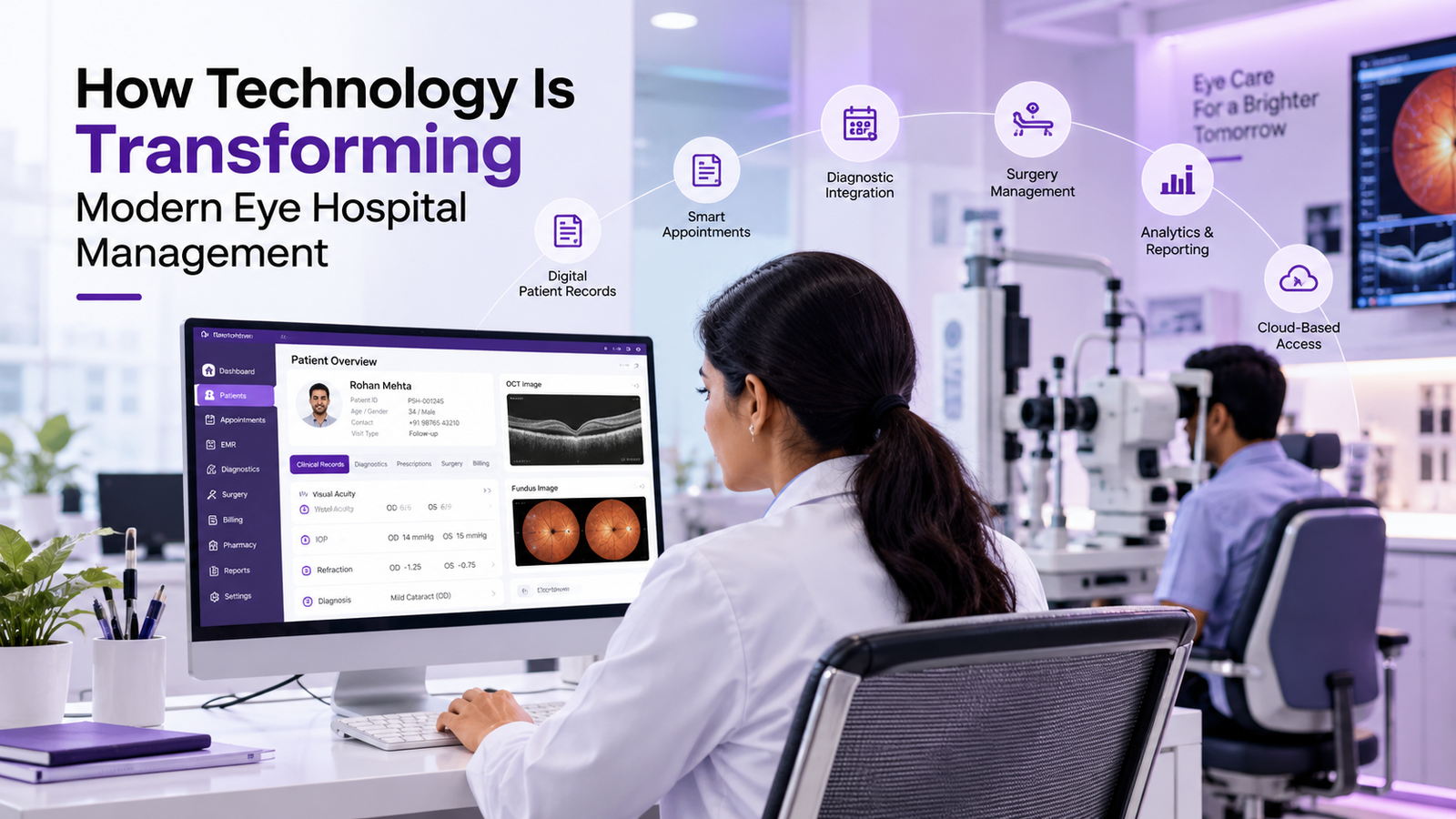
The way eye hospitals manage patients, clinical information, diagnostics, and administrative operations is changing rapidly. As patient volumes increase and ophthalmology becomes more dependent on digital diagnostics, hospitals need systems that can connect different parts of their daily workflow.
Technology is helping eye hospitals move beyond paper records and disconnected processes toward more organized digital operations. Electronic medical records, cloud-based platforms, diagnostic integrations, automated scheduling, analytics, and digital communication are becoming important components of modern eye-care management.
The goal is not simply to introduce more technology. It is to use the right technology to make hospital operations more efficient while helping healthcare professionals access the information they need.
Why Is Technology Important for Modern Eye Hospitals?
An eye hospital handles a wide range of clinical and administrative activities every day.
A typical patient journey may include:
Registration → Appointment → Consultation → Eye Examination → Diagnostic Testing → Diagnosis → Treatment/Surgery → Billing → Follow-Up
Each stage generates information that may need to be accessed by different teams.
When these activities are managed through separate systems or paper-based processes, information can become fragmented. Staff may spend additional time searching for records, entering information repeatedly, or transferring data between departments.
Integrated digital technology can help connect these workflows and create a more consistent flow of information.
1. Electronic Medical Records Are Changing Patient Management
One of the most important developments in modern eye hospital management is the adoption of electronic medical records.
Instead of maintaining physical files, hospitals can store patient information digitally, including:
- Medical history
- Previous consultations
- Visual acuity
- Refraction details
- Intraocular pressure
- Diagnoses
- Prescriptions
- Treatment plans
- Surgical history
- Follow-up notes
Authorized healthcare professionals can access relevant information more efficiently during subsequent visits.
This can be particularly useful for patients with conditions requiring long-term monitoring, such as glaucoma or diabetic eye disease.
2. Digital Appointment Management Improves Hospital Coordination
Managing appointments manually can become difficult when an eye hospital has multiple doctors, departments, diagnostic services, and surgical schedules.
Digital appointment systems can help coordinate:
- New patient consultations
- Follow-up appointments
- Doctor availability
- Diagnostic tests
- Surgery schedules
- Rescheduling
- Patient reminders
A centralized scheduling system can provide staff with better visibility into daily operations and help reduce avoidable scheduling conflicts.
For patients, digital appointment management can also create a more convenient experience.
3. Diagnostic Technology Is Becoming More Connected
Modern ophthalmology depends heavily on diagnostic equipment.
Eye hospitals may use technologies such as:
- OCT
- Fundus cameras
- Visual field analyzers
- Optical biometers
- Corneal topographers
- Autorefractors
- Keratometers
These devices generate valuable clinical information.
However, diagnostic technology becomes more useful when relevant information can be connected with the patient’s medical record.
Where compatible integrations are available, healthcare software can reduce manual data entry and help clinicians access diagnostic information alongside other patient details.
Before implementing a system, hospitals should confirm which devices and integration standards are supported.
4. Technology Is Streamlining Surgical Workflows
Eye hospitals often perform procedures such as cataract surgery and other ophthalmic surgeries.
Surgical management involves multiple steps, including:
- Pre-operative assessment
- Diagnostic testing
- Biometry
- Surgical scheduling
- Surgeon allocation
- Procedure documentation
- Post-operative instructions
- Follow-up appointments
Digital systems can help connect these activities and reduce reliance on separate spreadsheets, paper forms, and manual communication.
A centralized workflow can also make it easier for authorized staff to track the status of a patient’s surgical journey.
5. Cloud Technology Supports Growing Eye Hospitals
Cloud-based healthcare platforms are increasingly relevant for organizations with multiple departments or locations.
A multi-location eye hospital may need a system that allows authorized users to access relevant information across branches while maintaining appropriate access controls.
Cloud technology can support centralized management of healthcare information, depending on the platform’s architecture and security model.
However, hospitals should carefully evaluate:
- Data security
- Access controls
- Backups
- Disaster recovery
- Data ownership
- System availability
- Vendor support
- Regulatory requirements
Cloud adoption should be based on the hospital’s operational needs rather than simply following a technology trend.
6. Automation Can Reduce Administrative Work
Hospital staff spend considerable time performing repetitive administrative tasks.
Technology can help automate or simplify processes such as:
- Patient registration
- Appointment reminders
- Billing
- Report generation
- Follow-up scheduling
- Inventory tracking
- Insurance workflows
- Routine notifications
Reducing repetitive manual work can allow administrative teams to focus on tasks that require human interaction and decision-making.
Automation should complement staff rather than remove necessary human oversight from healthcare processes.
7. Digital Billing and Insurance Improve Financial Workflows
Financial management is another important part of eye hospital operations.
Hospitals may need to manage consultation charges, diagnostic fees, surgical procedures, packages, insurance claims, and payments.
An integrated system can connect financial information with patient and treatment records.
This can help reduce duplication and make it easier for administrators to track revenue and outstanding transactions.
For hospitals working with multiple insurance providers, software should be evaluated according to the organization’s specific claims and billing requirements.
8. Analytics Helps Hospital Administrators Make Informed Decisions
Modern healthcare systems generate significant amounts of operational data.
Analytics tools can help hospital administrators understand:
- Patient volumes
- Appointment trends
- Doctor schedules
- Procedure volumes
- Surgery activity
- Revenue
- Department performance
- Follow-up patterns
- Resource utilization
For example, if a hospital identifies consistently high demand for a particular service, management can use that information when planning staffing or scheduling.
Analytics does not replace management judgment. Instead, it provides organized information that can support better planning.
9. Patient Communication Is Becoming More Digital
Patient expectations are also changing.
Patients increasingly value convenient communication regarding appointments, reports, follow-ups, and treatment-related information.
Depending on the software and communication channels used, digital healthcare platforms can support:
- Appointment confirmations
- Reminders
- Follow-up notifications
- Prescription-related communication
- Patient instructions
- Future appointment scheduling
For patients who require multiple visits, better communication can help create a more organized care journey.
10. Security Is a Critical Part of Digital Eye Hospital Management
Digital transformation also increases the importance of healthcare data security.
Patient medical records contain sensitive information, so hospitals should evaluate security before adopting any digital platform.
Important considerations include:
- User authentication
- Role-based access
- Data encryption
- Backup procedures
- Audit trails
- Access monitoring
- Data recovery
- Employee permissions
Different users should only have access to the information required for their responsibilities.
For example, a receptionist, billing executive, nurse, doctor, and hospital administrator may require different levels of system access.
How to Choose the Right Technology for an Eye Hospital
Technology should be selected based on actual operational requirements.
Before implementing a platform, hospital management should consider:
Clinical Requirements
Does the system support ophthalmology-specific workflows and documentation?
Integration
Can it work with relevant diagnostic equipment and existing healthcare systems?
Usability
Can doctors and staff use it efficiently without unnecessary complexity?
Scalability
Can it support additional users, departments, locations, and patient volumes?
Security
Does it provide appropriate access controls, backups, and data protection measures?
Reporting
Can management obtain the information required for operational decision-making?
Support
Does the provider offer implementation assistance, training, and technical support?
A practical demonstration using real-world hospital workflows can be more useful than evaluating a feature list alone.
What Should Hospitals Look for in Eye Hospital Software?
As hospitals evaluate the best Eye hospital software for their requirements, they should look beyond basic patient management and consider clinical workflows, diagnostic integration, security, scalability, and analytics.
The right platform should fit the hospital’s existing processes while also providing room for future growth.
Rather than choosing software simply because it has many features, hospital administrators should determine whether those features solve real operational challenges.
The Role of AI in Modern Eye Hospital Management
Artificial intelligence is becoming an increasingly important part of healthcare technology.
In ophthalmology, AI may support areas such as:
- Image analysis
- Data analysis
- Workflow automation
- Reporting
- Clinical decision support
However, AI should be treated as a supporting technology. Medical diagnosis and treatment decisions should remain under the responsibility of qualified healthcare professionals.
Hospitals should also assess the accuracy, transparency, security, and intended use of AI tools before integrating them into clinical workflows.
How Purple Sky Health Supports Digital Healthcare
Purple Sky Health provides a cloud-based digital healthcare platform designed to help healthcare providers manage clinical and administrative operations through a connected digital environment.
The platform supports areas such as patient records, appointments, billing, insurance, analytics, and other healthcare workflows.
For eye hospitals exploring digital transformation, an integrated healthcare platform can help bring different operational functions together and create a more organized approach to healthcare management.
The objective of digital transformation should ultimately be to make healthcare operations more connected and efficient while keeping patient care at the center.
The Future of Eye Hospital Management
The future of eye hospital management is likely to involve greater integration between electronic medical records, diagnostic systems, cloud platforms, analytics, patient communication, and AI-enabled technologies.
Hospitals that adopt digital systems should therefore consider both current requirements and future scalability.
The focus should remain on practical improvements such as:
- Better information management
- Faster access to relevant records
- Efficient clinical workflows
- Reduced administrative duplication
- Secure data management
- Better operational visibility
- Improved patient experience
Technology works best when it supports healthcare professionals rather than making their workflows unnecessarily complicated.
Conclusion
Technology is transforming modern eye hospital management by connecting clinical, diagnostic, administrative, and financial workflows within increasingly digital environments.
From electronic medical records and diagnostic integration to cloud platforms, analytics, automation, and patient communication, these technologies can help hospitals manage growing operational complexity.
However, successful digital transformation requires more than purchasing software. Hospitals should evaluate their actual requirements, assess security and integration capabilities, train their teams, and choose technology that can scale with future needs.
With a well-planned digital strategy, modern eye hospitals can build more organized, connected, and data-driven workflows while keeping efficient patient care at the center of their operations.
Frequently Asked Questions
1. How is technology changing eye hospital management?
Technology is helping eye hospitals digitize patient records, appointments, diagnostics, surgery workflows, billing, analytics, communication, and other administrative processes.
2. What are the benefits of digital patient records in eye hospitals?
Digital records can make patient information easier for authorized healthcare professionals to access, organize, update, and review during follow-up consultations.
3. Can eye hospital software integrate with diagnostic equipment?
Some healthcare platforms support integration with compatible ophthalmology diagnostic devices. Hospitals should confirm supported devices and integration capabilities with the software provider.
4. Is cloud technology useful for multi-location eye hospitals?
Cloud-based platforms can support centralized access and management across locations, subject to the platform’s architecture, security controls, connectivity, and organizational requirements.
5. What should an eye hospital consider before adopting digital technology?
Hospitals should evaluate clinical functionality, usability, integrations, security, scalability, reporting, implementation support, training, and the software’s ability to meet future requirements.