


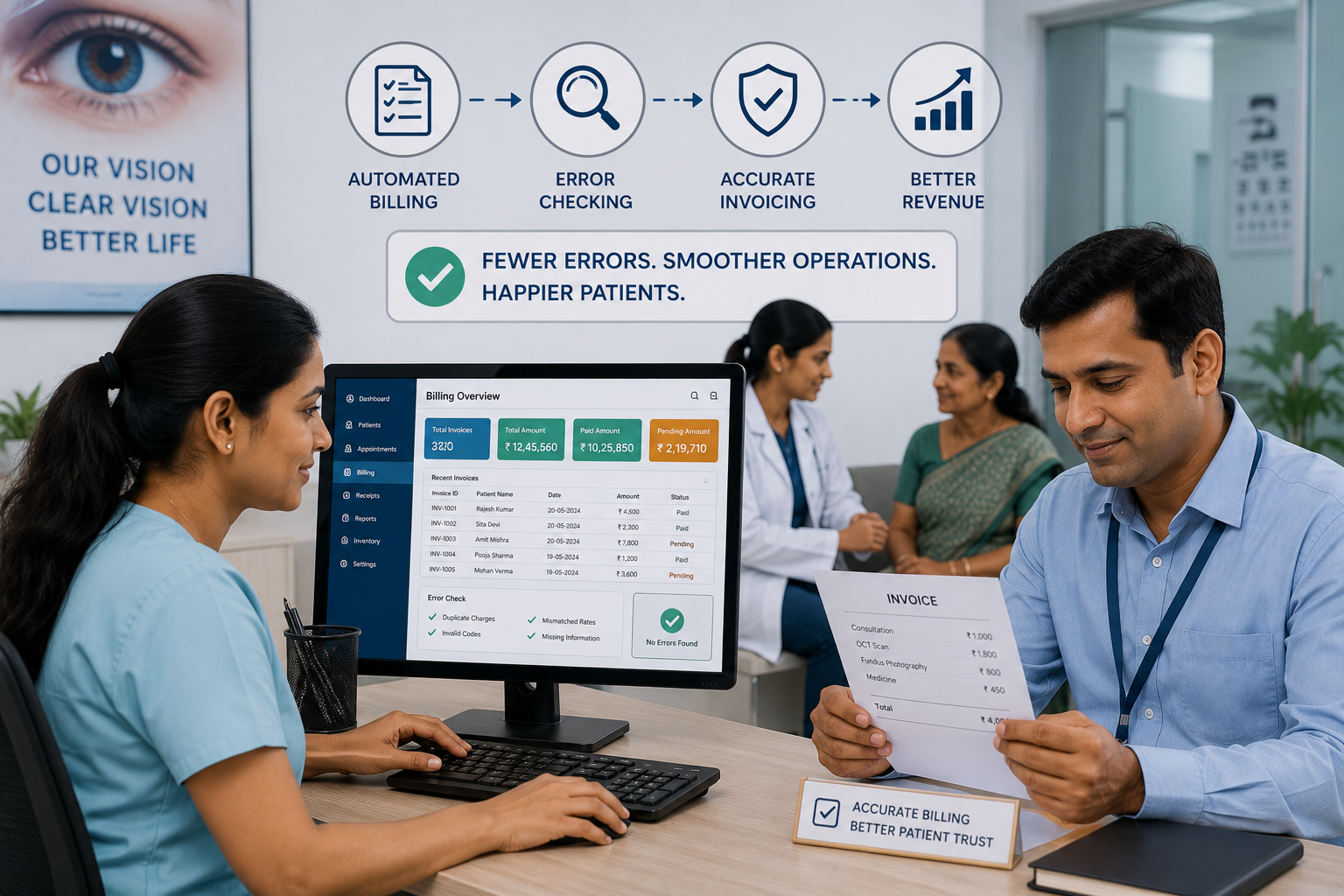
In any healthcare facility, accurate billing is just as important as quality patient care. For eye hospitals, billing can become particularly complex due to consultations, diagnostic procedures, surgeries, optical services, insurance claims, medications, and follow-up treatments. Even a small billing mistake can lead to delayed payments, claim rejections, revenue loss, and patient dissatisfaction.
Many eye hospitals still struggle with manual billing processes, disconnected systems, and human errors that affect financial performance. Fortunately, modern healthcare software is helping hospitals overcome these challenges by automating billing workflows and improving accuracy at every stage.
In this article, we’ll explore how eye hospitals can reduce billing errors using software and improve overall operational efficiency.
Why Billing Errors Are a Major Concern for Eye Hospitals
Billing errors do more than create financial discrepancies. They can affect the entire patient experience and place unnecessary strain on administrative teams.
Common consequences of billing mistakes include:
- Delayed insurance reimbursements
- Revenue leakage
- Duplicate billing
- Incorrect patient invoices
- Compliance issues
- Increased administrative workload
- Patient complaints and disputes
As patient volumes grow and healthcare regulations become more complex, relying on manual processes increases the likelihood of errors.
Common Billing Challenges Faced by Eye Hospitals
Manual Data Entry Errors
When patient information, treatment details, and billing data are entered manually, mistakes can occur easily. Incorrect procedure codes, missing information, and duplicate entries often lead to inaccurate invoices.
Even experienced staff members can make errors when managing large volumes of patient records and transactions daily.
Disconnected Systems
Many hospitals use separate systems for patient records, appointments, billing, inventory, and insurance management.
When these systems do not communicate with each other, staff may need to transfer information manually, increasing the risk of inaccuracies and inconsistencies.
Insurance Claim Issues
Insurance billing often requires precise documentation and coding. Missing information or incorrect entries can result in claim denials and delayed reimbursements.
Managing insurance claims manually can be time-consuming and challenging for administrative teams.
Complex Ophthalmology Procedures
Eye hospitals frequently perform a wide range of services, including consultations, diagnostics, cataract surgeries, LASIK procedures, retinal treatments, and optical sales.
Tracking and billing each service accurately becomes difficult without a centralized software solution.
IOL (Intraocular Lens) Inventory and Billing Leakages
One of the most significant yet often overlooked sources of revenue leakage in eye hospitals is the management of Intraocular Lenses (IOLs). Different patients require different types of lenses based on their diagnosis, surgical requirements, and treatment plans. In many hospitals, lens inventory is supplied and managed by vendors who stock various IOLs within the hospital premises.
Without a structured IOL management system, hospitals may face challenges such as incorrect lens billing, unbilled lens usage, inventory mismatches, and difficulties in tracking which lens was implanted for a specific patient. These issues can directly impact revenue and operational transparency.
Modern ophthalmology software addresses this challenge through a dedicated IOL Management Library concept. Every lens is registered within a centralized database with details such as model, manufacturer, batch number, pricing, and stock availability. When a lens is selected during surgery, the system automatically links it to the patient’s record and billing process, ensuring accurate inventory tracking and eliminating billing leakages.
Optical Frame and Inventory Management Challenges
Many eye hospitals operate optical stores alongside clinical services. Managing optical frames, lenses, accessories, and related inventory manually can lead to stock discrepancies, billing errors, and revenue losses.
Without proper inventory controls, hospitals may struggle to track frame sales, stock movement, damaged products, or product replacements. Missing inventory records can also make it difficult to identify slow-moving and fast-selling products.
Advanced eye hospital software incorporates barcode-based inventory management for optical products. Each frame and optical item is assigned a unique barcode, enabling real-time tracking from procurement to sale. Barcode scanning during billing ensures accurate invoicing, automatic stock updates, and improved inventory visibility. This reduces manual errors while helping hospitals maintain tighter control over optical store operations.
How Software Helps Reduce Billing Errors
Automated Billing Processes
Modern healthcare software automates much of the billing workflow by capturing patient and treatment information directly from the system.
This reduces dependence on manual data entry and ensures that billing information remains consistent across departments.
Automated billing also minimizes the chances of missing charges or duplicate invoices.
Integration with Electronic Medical Records
When billing systems are connected to Electronic Medical Records (EMR), treatment information can automatically flow into the billing process.
This integration helps ensure that services performed are accurately reflected in patient invoices, reducing discrepancies between clinical documentation and billing records.
Real-Time Data Synchronization
Software solutions provide real-time updates across departments, ensuring that everyone works with the same information.
Whether a patient undergoes a diagnostic test, receives medication, or schedules surgery, the billing system can immediately reflect those changes.
This reduces delays and improves billing accuracy.
Automated Insurance Processing
Healthcare software can simplify insurance claim management by automatically capturing required information and validating entries before submission.
This helps reduce claim rejections and accelerates reimbursement cycles.
Many systems also provide alerts for missing documentation, helping staff resolve issues before claims are submitted.
Benefits of Billing Automation for Eye Hospitals
Improved Revenue Management
Accurate billing ensures that hospitals receive appropriate compensation for services provided.
By reducing missed charges and billing errors, hospitals can strengthen their revenue cycle and improve financial performance.
Faster Payment Collection
When invoices are accurate and generated promptly, payment collection becomes more efficient.
Patients and insurance providers are more likely to process payments without delays when billing information is clear and error-free.
Enhanced Compliance
Healthcare regulations and insurance requirements continue to evolve.
Software solutions help hospitals maintain accurate records, generate audit trails, and comply with industry standards, reducing compliance-related risks.
Better Patient Experience
Billing disputes can negatively affect patient satisfaction.
Accurate and transparent billing creates trust and reduces confusion, contributing to a more positive patient experience.
Key Features Eye Hospitals Should Look For
Integrated Billing and EMR
A unified platform helps eliminate duplicate data entry and ensures consistency across clinical and financial operations.
The closer the connection between patient records and billing, the lower the risk of errors.
Procedure and Service Tracking
Eye hospitals should choose software that accurately tracks consultations, diagnostics, surgeries, medications, and optical services.
Comprehensive tracking helps ensure that every billable service is captured correctly.
Insurance Management Tools
Built-in insurance processing features can simplify claims management and reduce administrative workload.
Automated validation checks can help identify potential issues before claims are submitted.
Reporting and Analytics
Advanced reporting tools provide insights into billing performance, claim status, payment trends, and revenue cycles.
These insights help management identify bottlenecks and make informed financial decisions.
The Role of Specialized Eye Hospital Software
Generic hospital software may not fully address the unique operational needs of ophthalmology practices. Eye hospitals require specialized workflows, procedure tracking, and documentation tools tailored to eye care.
This is where ophthalmology-specific solutions become valuable. Specialized platforms are designed to align with clinical processes while supporting accurate billing and efficient patient management.
How Purple Sky Health Supports Digital Healthcare Operations
Purple Sky Health provides a comprehensive digital healthcare platform that helps healthcare providers manage clinical, administrative, and financial operations through a secure cloud-based environment.
The platform supports patient management, appointments, billing, insurance processing, analytics, and operational workflows within a unified system. By bringing critical healthcare functions together, hospitals can reduce inefficiencies, improve accuracy, and make better data-driven decisions.
Serving healthcare organizations across multiple regions, Purple Sky Health focuses on helping providers streamline operations while delivering better patient experiences.
How WebNetram Helps Eye Hospitals Reduce Billing Errors
Developed by Purple Sky Health, WebNetram is a specialized Ophthalmology EMR and Eye Hospital Software designed specifically for eye care providers.
Beyond patient records, appointments, and billing, WebNetram offers dedicated ophthalmology-focused inventory controls that help reduce revenue leakages commonly seen in eye hospitals. The platform supports IOL Management through a centralized library concept, allowing hospitals to track lens inventory, vendor-supplied stock, lens allocation during surgeries, and automated billing integration. This ensures that every implanted lens is accurately recorded, billed, and linked to the patient’s clinical record.
WebNetram also supports Optical Inventory Management through barcode-enabled tracking of frames, lenses, and optical accessories. By automating stock movement and linking sales directly to billing, the system helps prevent inventory discrepancies and improves revenue accountability.
With integrated clinical, billing, inventory, insurance, and operational workflows, WebNetram helps eye hospitals improve financial accuracy, strengthen inventory control, reduce manual errors, and enhance overall operational efficiency.
Future of Billing Management in Eye Hospitals
As healthcare organizations continue adopting digital solutions, billing automation will become increasingly important. Artificial intelligence, predictive analytics, and intelligent workflow automation are already helping hospitals improve billing accuracy and operational performance.
Eye hospitals that embrace modern software solutions are better positioned to reduce administrative burdens, improve revenue management, and enhance patient satisfaction.
Conclusion
Billing errors can significantly impact an eye hospital’s financial health, operational efficiency, and patient experience. Manual processes, disconnected systems, and complex insurance requirements often contribute to mistakes that can be costly and time-consuming to resolve.
By implementing modern healthcare software, eye hospitals can automate billing workflows, improve data accuracy, streamline insurance processing, and strengthen revenue cycle management. Solutions such as WebNetram, developed by Purple Sky Health, demonstrate how specialized ophthalmology software can help eye care providers reduce billing errors while improving overall operational efficiency.
As the healthcare industry continues its digital transformation, investing in the right software is becoming an essential step toward more accurate billing, better patient care, and sustainable growth.